
Federal Release Paths from Harney
No federal BOP institution is located in Harney County. The federal system appears in a local release inquiry only when the Harney booking disposition, a court case, or another official record points to it. A person can leave the county jail for U.S. Marshals custody before sentence. A sentenced person may later be designated to a BOP institution. Those are transfers, not community releases.
BOP custody can end with a recorded release date, but federal supervised release may continue under a U.S. district court and U.S. Probation. “Not in BOP custody” describes the BOP relationship only. The person could be with USMS, another jurisdiction, on supervision, or fully released. Keep the exact status and seek the federal court order when the wider legal position matters.
| Federal stage | Primary confirmation |
|---|---|
| Harney handoff | County release disposition and destination |
| Federal pretrial custody | Federal docket and USMS |
| BOP sentence | BOP locator and judgment |
| BOP release | Locator release date and BOP records |
| Supervised release | District-court orders and U.S. Probation |
Search Federal Release Records
The BOP Inmate Locator covers federal inmates from 1982 to the present and includes some older data. Search by BOP register, DCDC, FBI, or INS number when available. A number is safer than a name. Otherwise use name plus the listed demographic filters. Compare the register number and all displayed identifiers.
- Ask Harney County whether the destination was BOP or USMS.
- Obtain the federal register number or other agency identifier.
- Search by number, then use name filters if needed.
- Read the Release Date and Location fields together.
- Check the federal docket for detention, judgment, and supervision.
- Use BOP or USMS records requests for missing agency events.
The BOP locator defines its columns as Name, Register Number, Age, Race, Sex, Release Date, and Location. Present age appears rather than age at release. Data generally update daily. That timing means a new event may not appear at once.
The official locator screen shows the federal fields and search choices. Review the live BOP locator before entering identifiers.
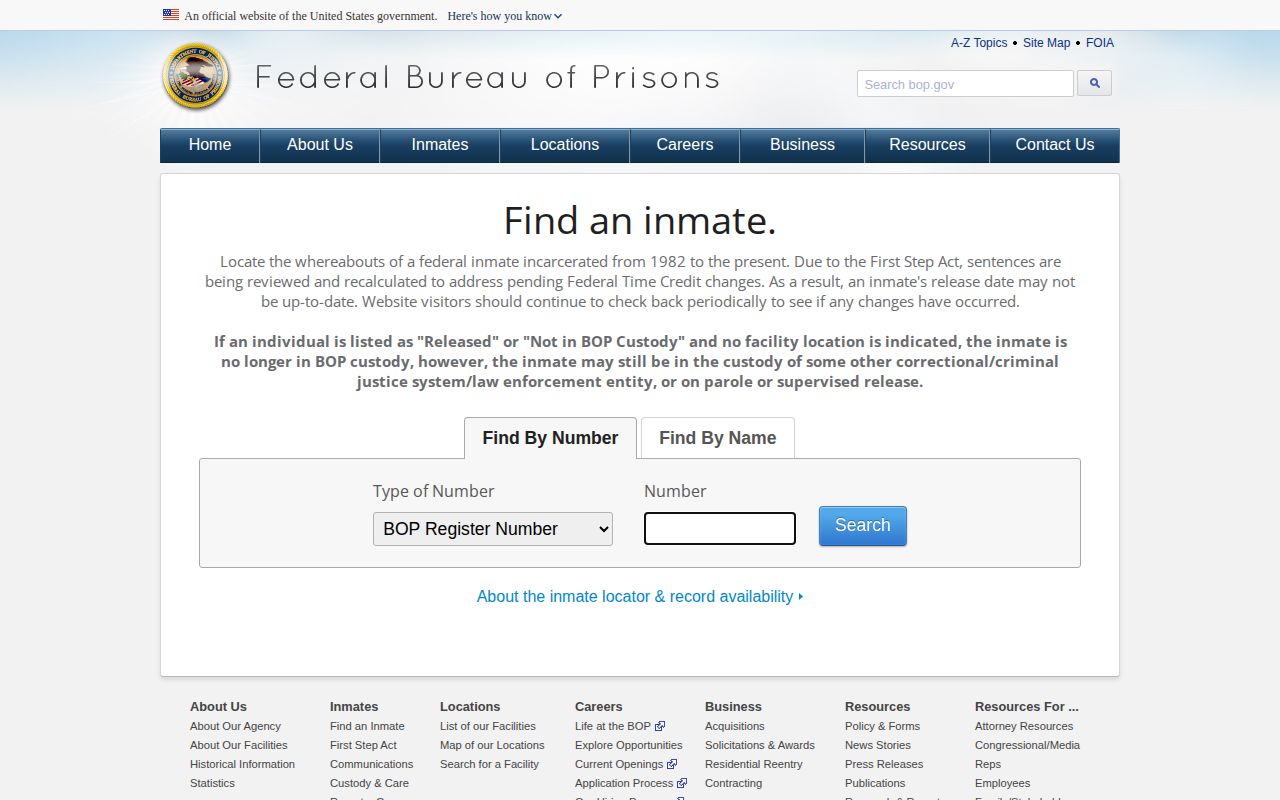
The captured interface supports the federal lookup route, but the result still must be connected to the Harney County event through the county destination field or federal case.
Read Federal Release Status
A past release date with no institution indicates that BOP records release on that date. A Location value of “RELEASED” also means the person is no longer in BOP custody. A future release date is projected and can change. “UNKNOWN” can mean that the term is not yet determined, including some pretrial or civil matters. A known death can appear in the release-date column, so never assume every past date is community release without reading the full record.
“IN TRANSIT” requires extra care. BOP explains that a pretrial person may be removed by USMS and released by a court without later notice to BOP. The locator can also include people who never served a federal sentence, such as a dismissed pretrial defendant, material witness, or civil-contempt detainee. Corroborate the status with the docket and agency record.
- Released
- No longer in BOP custody as of the recorded date.
- Projected date
- A future BOP estimate, not an executed event.
- In transit
- Movement or USMS control that needs separate confirmation.
- Not in BOP custody
- No current BOP custody, not proof of freedom from all custody.
USMS Custody After Harney Release
USMS generally manages federal pretrial and transport custody. It can house people in contract state or local facilities. A newly arrested federal defendant may not appear as a designated BOP prisoner. Search the federal docket and ask Harney County whether the receiving agency was USMS before treating a blank BOP search as release proof.
The District of Oregon lists federal divisions in Portland, Eugene, Medford, and Pendleton, not Burns. The eastern Oregon courthouse is the John F. Kilkenny U.S. Post Office and Courthouse at 104 SW Dorion Avenue in Pendleton. Court geography does not prove where a person was held. USMS may place a defendant elsewhere.
Federal docket entries can show detention, conditional release, dismissal, acquittal, judgment, designation, transfer, and supervised-release events. PACER and CM/ECF are court tools, while USMS FOIA is the agency record route. Ask each source only for records it keeps.
The Harney County release search begins with the county booking event. Its destination field is the bridge to the federal case and custodian.
Request Federal Release Records
Use BOP FOIA for BOP-held records and USMS FOIA for Marshals-held records. Include the full name, register number or other identifier, federal case number, and exact records sought. Useful items include admission or designation, transfer, status history, actual release, and release destination to the extent releasable. A narrow date range and named record help the agency locate the right file.
The federal judgment explains sentence and supervised-release terms. BOP executes the imprisonment portion. A BOP release does not cancel a term of supervised release. Review later district-court orders for modification, revocation, or discharge. Use the exact legal term shown.
If a release date changes, preserve each dated source. BOP flags that some dates can be affected by First Step Act calculations. Do not do independent arithmetic from the sentence length. The agency computation, current locator, and court judgment must be reconciled.
Note: County staff cannot produce a federal prison file that BOP or USMS holds, even when the federal path began with a Harney booking.
Separate Federal and Local Releases
A reliable timeline keeps systems apart. Record the Harney booking number, county transfer timestamp, named federal receiver, federal case number, BOP register number, federal admission or status, actual BOP release, supervised-release start, and later discharge. Label a missing item “not established.”
Names, ages, and photographs can collide. Use agency numbers and case identifiers. If the BOP result and county record describe different dates, ask whether one is the county handoff and the other is the later federal release. Both may be accurate because they mark different custody stages.
An ICE transfer is also a different federal route. Do not use BOP as a substitute for the ICE locator. Likewise, a person under USMS pretrial control may not have a normal BOP designation. Follow the agency named in the county record rather than searching every federal system and merging results.
The final statement should be bounded: BOP released the person on the displayed date, Harney County transferred the person on another date, or current community status was not established. That wording matches the records without extending them beyond their scope.
Federal release questions route by custodian. These are system contacts rather than a local facility desk. Use the agency identifier and federal case number so the request reaches the right office. A local address would be misleading because a person may be held, moved, sentenced, and released through agencies in different places.
Federal Release Record Routes
BOP custody and release: BOP Inmate Locator and BOP FOIA
Federal pretrial custody and transport: USMS and USMS FOIA
Sentence and supervised release: District of Oregon court docket
No BOP institution is located in Harney County
Federal Release Timeline Evidence
A federal custody timeline may contain several agencies before BOP release. Begin with the Harney County booking event and its named receiver. If USMS accepted the person, use the District of Oregon docket for detention or conditional-release orders and use the Marshals record for transport or custody facts. A later BOP designation belongs after that stage. The BOP register number links locator results and records more safely than a name alone.
Record each federal locator field exactly. A future Release Date is projected. “RELEASED” as the location means BOP custody ended, while “Not in BOP custody” does not establish freedom from all custody. “IN TRANSIT” may reflect movement under USMS control. “UNKNOWN” can appear where a term is not determined. BOP also notes daily updates and special cautions for First Step Act calculations. Preserve the access date rather than presenting a screen as timeless.
Request the admission or designation, transfer history, actual release entry, and release destination from BOP when the public result is too brief. The federal judgment supplies the sentence and supervised-release term. Later district-court orders can modify, revoke, or discharge supervision. Those court actions are separate from BOP's physical release record.
If a county and BOP date differ, both may be correct. One can mark departure from Harney custody and the other the end of a later federal prison term. Label each event with its agency and never collapse the interval into one release date.